WSHAThe Official Governing Body of Seagull Hunting
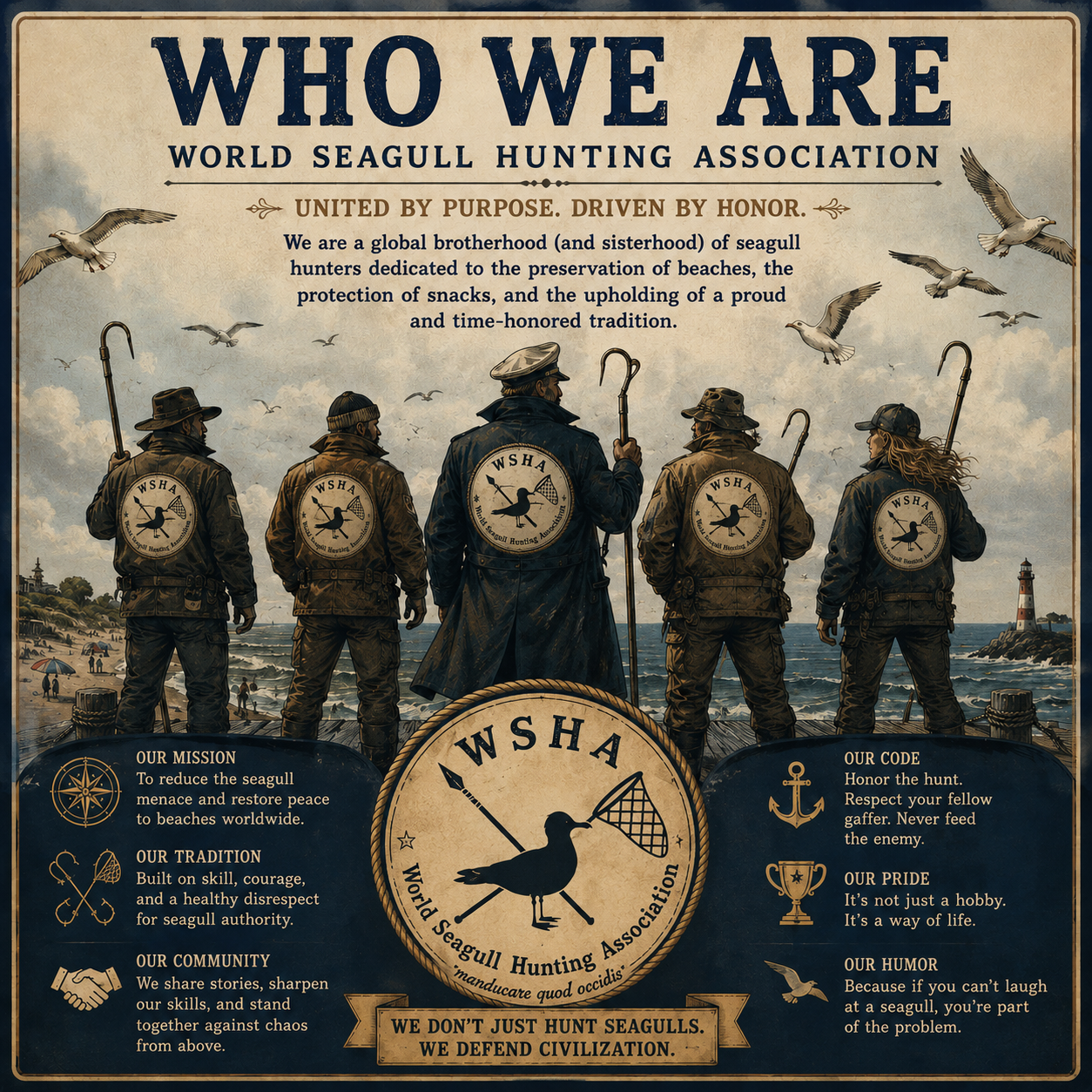
The World Seagull Hunting Association is the official regulatory and advocacy organization for the sport of seagull hunting.
Founded to preserve the traditions, standards, and ethics of the hunt, WSHA exists to provide structure to a practice that has long been misunderstood by the public and misrepresented by its critics. Our role is to protect responsible hunters, establish clear rules of conduct, maintain equipment and keeper standards, and ensure that the sport continues with discipline, fairness, and respect for its history.
Our guiding principle is simple:
Manducare quad occidis
Kill what you eat.
This motto reflects the foundation of WSHA’s values: responsible pursuit, full use, and respect for the traditions that came before us.
Our Purpose
WSHA was created because seagull hunting cannot exist without standards.
For generations, coastal hunters operated according to local customs, family traditions, and informal codes passed down from one season to the next. While these traditions remain important, the growth of the sport created a clear need for uniform regulations, official classifications, and recognized field procedures.
Today, WSHA serves as the central authority for:
Gaff standards and equipment classifications
Keeper size verification
Net boy certification and field authority
Subspecies identification
Ethical bait restrictions
Hunter conduct standards
Historical recordkeeping
Legislative advocacy for hunters’ rights
We believe that regulation strengthens the sport. Clear standards protect the integrity of the hunt, reduce disputes in the field, and ensure that every recognized keeper is earned according to the same rules.
Our History
The history of seagull hunting is closely tied to the history of coastal life itself.
Wherever people gathered along the shoreline, gulls followed. They occupied docks, boardwalks, fishing piers, beaches, and harbors. Over time, hunters developed techniques, tools, and traditions to manage the ever-present challenge posed by gull populations and their increasingly aggressive behavior around food, commerce, and public recreation.
As the sport evolved, so did the need for a formal institution.
WSHA emerged to bring order to the hunt. What began as a loose network of coastal hunters, gaff makers, net boys, and regional clubs became a unified organization dedicated to preserving the practice, documenting its history, and defending it from outside pressure.
The stories of legendary gulls such as Old Graybeak, Blackbeak, and Lord Gullington III remain part of that heritage. While these accounts have grown through retelling, they represent something important: the respect every serious hunter has for the intelligence, resilience, and unpredictability of the gull.
What We Stand For
WSHA stands for responsible hunting.
We do not support reckless conduct, unlawful baiting, unsafe equipment use, or unsanctioned keeper claims. The sport depends on discipline. Every hunter has a responsibility to know the regulations, respect field officials, and conduct themselves in a way that reflects well on the association.
We also stand for the rights of hunters.
In recent years, activist groups such as Stop the Hunt have worked to challenge the legitimacy of seagull hunting and restrict the rights of those who participate in it. WSHA recognizes the importance of public dialogue, but we reject efforts to distort the nature of the sport or portray responsible hunters as careless or unethical.
Our position is clear: seagull hunting is a regulated tradition with established rules, internal oversight, and a long-standing cultural history. It deserves to be represented accurately.
The Role of the Net Boy
No discussion of WSHA would be complete without recognizing the role of the net boy.
The net boy is essential to the integrity of the hunt. In WSHA-sanctioned activity, the net boy is responsible for keeper verification, weight qualification, and certain field determinations. A legal keeper must meet the official 2.3-pound minimum and must be qualified by an authorized net boy.
This process exists to eliminate disputes, prevent exaggerated claims, and protect the credibility of official records.
A keeper is not a keeper because a hunter says it is.
A keeper is a keeper when the net boy says it is.
Equipment Standards
WSHA maintains formal standards for approved hunting equipment.
The maximum legal gaff length is 14 feet. This regulation exists to preserve fairness and prevent unsafe or excessive field practices. Hunters may choose between traditional stainless steel gaffs or lighter carbon fiber models, depending on preference, experience, and hunting conditions.
Gaffs may also be classified by beak rating, which reflects striking power and field capability. Single beak, double beak, and triple beak rated gaffs each serve different purposes, with triple beak rated equipment remaining rare and subject to strict scrutiny.
These standards are not cosmetic. They are central to the fairness and safety of the sport.
Ethical Standards
WSHA maintains strict rules regarding bait and field conduct.
Most notably, the use of Cheez-Its is prohibited. Following the 1986 real-cheese controversy and the legal challenges that followed, WSHA determined that Cheez-Its provided an unfair advantage and violated the spirit of ethical pursuit.
The ruling remains one of the most important regulatory decisions in the association’s history.
Responsible hunting requires more than technical compliance. It requires restraint, judgment, and respect for the standards that protect the sport from becoming careless or exploitative.
Classification and Conservation of Records
WSHA recognizes multiple gull families and subspecies, with blue beak and gray beak families representing the two primary classifications along the East Coast.
Accurate classification is important for field reporting, historical records, and regional regulation. While informal names and local terminology remain part of the culture, WSHA continues to work toward consistent identification standards across all sanctioned chapters.
The association also maintains records of notable hunts, disputed keepers, legendary gulls, and major regulatory decisions. These records preserve the history of the sport and provide future hunters with a clearer understanding of the traditions they inherit.
Advocacy and Public Responsibility
As both a regulatory body and advocacy organization, WSHA works to protect the interests of hunters while maintaining public trust.
We understand that seagull hunting is often controversial. We also understand that controversy is not a reason to abandon a lawful, structured, and historically significant tradition. WSHA’s responsibility is to ensure that the sport is practiced according to clear standards and defended with professionalism.
We engage with public concerns, respond to misinformation, and advocate for policies that recognize the rights of responsible hunters.
Our Commitment
The World Seagull Hunting Association is committed to preserving the future of seagull hunting through regulation, education, advocacy, and respect for tradition.
We believe the sport is strongest when it is held to high standards.
We believe hunters deserve representation.
We believe history matters.
We believe rules matter.
And above all, we believe that the hunt must remain fair, disciplined, and worthy of those who came before us.
Manducare quad occidis.
Kill what you eat.