World Seagull Hunting AssociationOfficial WSHA Rules, Standards, and Field Conduct
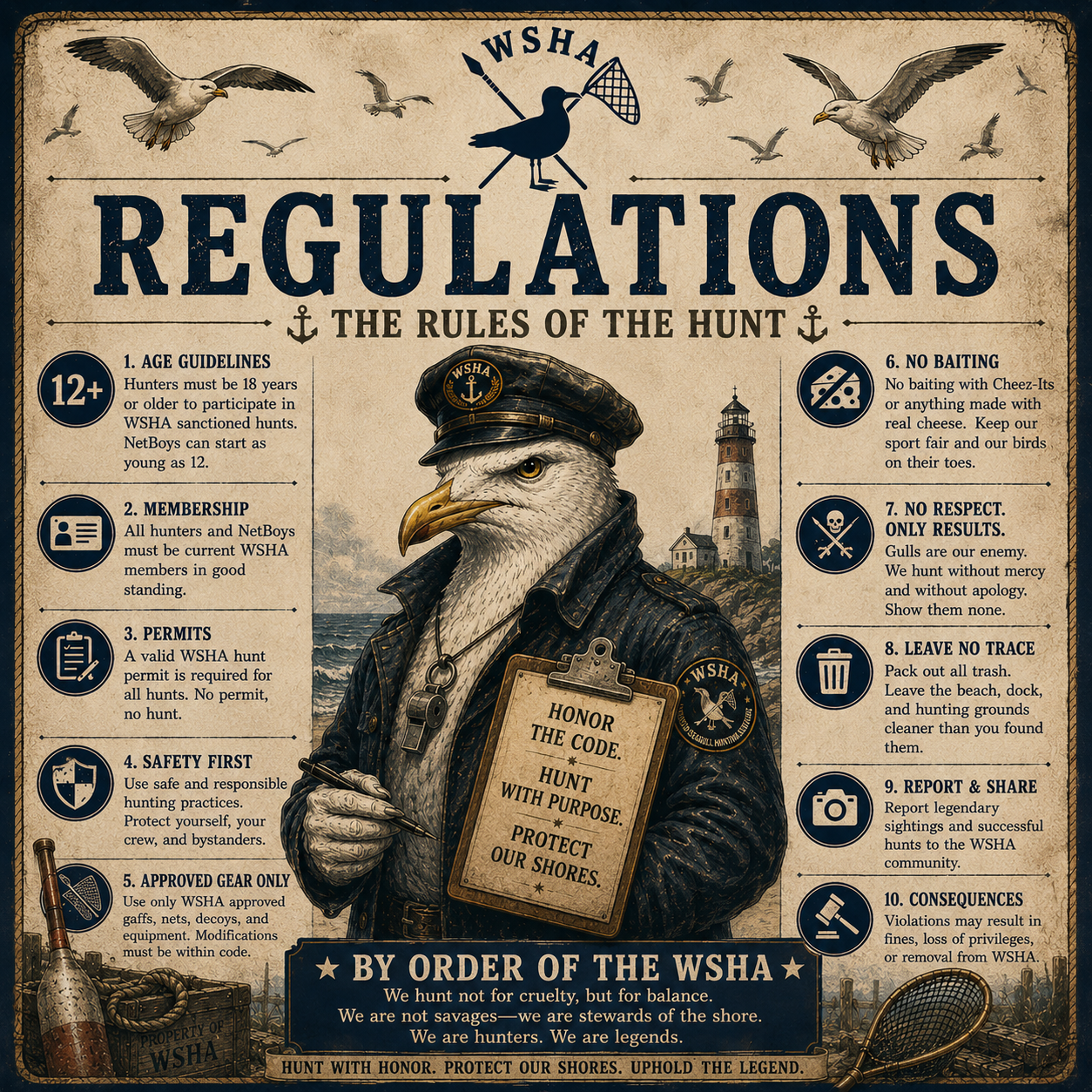
The World Seagull Hunting Association maintains the official regulations governing ethical seagull hunting, keeper certification, gaff usage, bait restrictions, net boy authority, and all related matters of beachside sporting conduct.
These regulations exist to protect the integrity of the hunt, the safety of participants, and the dignity of every man, woman, and child who has ever lost a French fry to a bird with criminal intent.
All WSHA members are expected to know, follow, and loudly reference these regulations whenever challenged by a member of Stop the Hunt, an unlicensed beach marshal, or a gull pretending to be injured.
Section 1: Gaff Regulations
The maximum legal gaff length for WSHA-sanctioned activity is 14 feet.
Length shall be measured from the rear grip to the forward-most striking curve. Decorative tassels, family crests, patriotic streamers, and anti-gull slogans do not count toward total length unless they materially improve reach, intimidation, or smugness.
Approved Gaff Materials
Stainless Steel Gaffs
Stainless steel remains a traditional favorite among old-school hunters. It offers durability, presence, and a satisfying sense of authority. However, stainless steel gaffs are heavy and may cause fatigue during long hunts, especially during boardwalk pursuits, dune maneuvers, or extended standoffs near funnel cake stands.
Carbon Fiber Gaffs
Carbon fiber gaffs are lighter, faster, and preferred by many modern hunters. They are especially useful during long coastal hunts where speed, control, and the ability to pivot around a beach chair are essential.
WSHA recognizes both stainless steel and carbon fiber as valid field materials, provided all other specifications are met.
Beak Ratings
Heavier gaffs are commonly classified by beak rating, which refers to penetration power, field authority, and the hunter’s likelihood of exaggerating at the banquet afterward.
Single Beak Rated
Standard field use. Appropriate for new hunters, smaller gulls, and basic fry-defense operations.
Double Beak Rated
Advanced field use. Recommended for experienced hunters pursuing larger gray beaks, aggressive boardwalk gulls, or known repeat offenders.
Triple Beak Rated
Maximum classification. Rare, powerful, and not to be used casually. Triple beak gaffs require advanced handling, two witnesses, and a net boy who has already made peace with the day’s events.
Any hunter falsely claiming a double or triple beak rating will be subject to review by the Gaff Standards Committee and may be forced to explain himself publicly over lukewarm clam chowder.
Section 2: Keeper Regulations
A legal keeper must weigh at least 2.3 pounds.
All keepers must be officially qualified by a certified WSHA net boy. No hunter may self-certify a keeper, estimate a keeper, or claim “it felt heavy when it hit the sand.”
The net boy’s ruling is final.
Keeper Verification Procedure
Upon capture, the gull must be presented to the official net boy for inspection and weighing. The net boy shall determine:
Total weight
Beak family classification
General field condition
Whether the hunter is telling the truth
Whether the gull appears to be “mostly feathers and attitude”
Any gull weighing under 2.3 pounds shall be considered undersized and must be released with a formal verbal warning.
Acceptable warnings include:
“Tell your friends.”
“Next year, pal.”
“Go steal from someone else.”
“WSHA remembers.”
Section 3: Net Boy Authority
The net boy is not an accessory to the hunt.
The net boy is the backbone of the sport.
All official keeper determinations, disputed weights, field measurements, and post-gaff handling procedures fall under net boy authority. A hunter may disagree with a net boy privately, respectfully, and at a safe distance, but may not overrule him.
Any attempt to bribe, intimidate, distract, or confuse a net boy shall be considered a serious violation.
Known bribe items include:
Funnel cake
Boardwalk fries
Half-eaten lobster rolls
Novelty sunglasses
Tokens from suspicious arcades
Promises of future “assistant gaffmaster” status
Due to the Lord Gullington III incident, all funnel cake-related interactions between hunters, gulls, and net boys are now subject to heightened review.
Section 4: Bait Restrictions
WSHA recognizes the use of traditional bait methods when conducted fairly, responsibly, and without chemical or cheese-based manipulation.
However, certain substances are strictly prohibited.
The Cheez-It Ban
The use of Cheez-Its is strictly forbidden in all WSHA-sanctioned hunts.
In 1986, after the public announcement that Cheez-Its were made with real cheese, the sport entered one of its darkest chapters. Hunters quickly discovered that gulls could not resist them. Worse, the real cheese was not properly processed by gull livers, creating an intoxication effect that gave hunters an unfair advantage.
The lawsuits that followed nearly destroyed the sport.
After years of hearings, protests, appeals, counter-appeals, and one highly emotional testimony from a net boy named Kevin, Cheez-Its were formally ruled unsportsmanlike conduct.
WSHA considers the Cheez-It era comparable to the steroids era in professional sports.
Records from that period remain under review.
Prohibited Bait Items
The following are prohibited:
Cheez-Its
Cheez-It dust
Crushed Cheez-Its disguised as sand
Real-cheese cracker blends
Nacho cheese foggers
Artificial “fry distress calls”
Remote-controlled pizza crusts
Funnel cake with cheese
Conditionally Permitted Bait
The following may be used under normal field conditions:
French fries
Lobster roll fragments
Plain crackers
Boardwalk pretzel pieces
Loose popcorn
Hot dog bun corners
Naturally dropped sandwich debris
All bait must be deployed in a manner consistent with fair chase principles. Excessive bait piles, bait pyramids, and bait trails leading directly into a minivan are prohibited.
Section 5: Species Classification
The East Coast is primarily home to two major gull families recognized by WSHA:
Blue Beak
Often faster, sharper, and more theatrical. Blue beaks are known for precision fry strikes, coordinated snack raids, and dramatic midair turns intended to embarrass hunters.
Gray Beak
Typically larger, older, meaner, and more psychologically damaging. Gray beaks are frequently associated with boardwalk dominance, bait suspicion, and prolonged eye contact.
Within these two families are numerous subspecies, local variants, and disputed categories, including but not limited to:
Boardwalk Gray
Atlantic Fry Gull
Blue Beak Sprinter
Parking Lot Screamer
Dune Creeper
Lobster Roll Harrier
Snack Cart Stalker
Common Umbrella Menace
Exotic Gull, pending verification
Hunters are expected to make a reasonable effort to identify the gull family before filing a field report. Misclassifying a common gray beak as an exotic gull for personal glory is considered dishonorable.
Section 6: Legendary Gull Protocol
Certain gulls are classified as legendary threats and require immediate reporting to WSHA headquarters.
These include:
Old Graybeak
Blackbeak
Lord Gullington III, Duke of French Fry Bay
Any gull wearing a hat
Any gull that appears to recognize your face
Any gull previously declared “definitely gaffed” but later seen stealing fries
Legendary gulls are not to be pursued alone.
Hunters encountering a legendary gull must notify a senior gaffmaster, secure a certified net boy, and avoid making eye contact for longer than three seconds.
Under no circumstances should any member accept a deal, bargain, challenge, riddle, or funnel cake-related proposition from Lord Gullington III.
Section 7: Field Conduct
All WSHA members must conduct themselves with honor.
The following behavior is prohibited:
Swinging a gaff in anger
Swinging a gaff near a wedding party
Swinging a gaff while holding a soft-serve cone
Using children as spotters without parental permission
Falsely yelling “keeper”
Impersonating a net boy
Claiming a gull “looked 2.3 pounds from here”
Entering a hunt under the influence of Cheez-It dust
Taking credit for another hunter’s gaff
Letting a gull steal your lunch and then pretending it was “part of the plan”
The beach is a sacred field of competition. Members are expected to represent WSHA with discipline, courage, and at least one clean shirt.
Section 8: Stop the Hunt Interactions
WSHA recognizes the existence of the activist group known as Stop the Hunt.
Members of Stop the Hunt may protest, chant, distribute pamphlets, cry near bait buckets, or accuse WSHA members of “taking this too seriously.”
WSHA members are expected to remain calm and professional.
Approved responses include:
“We respect your right to be wrong.”
“Please direct all complaints to the Office of Gull Accountability.”
“That gull knows what it did.”
“This is a regulated activity.”
“Talk to the net boy.”
Members may not throw fries near protesters in an attempt to prove a point. This has been tried. It did prove the point, but the Board has ruled it unnecessarily chaotic.
Section 9: Violations and Penalties
Violations of WSHA regulations may result in disciplinary action.
Possible penalties include:
Formal warning
Temporary gaff suspension
Mandatory net boy retraining
Loss of banquet seating privileges
Removal from the annual keeper board
Public apology to the Gaff Standards Committee
Cheez-It ethics seminar
Probationary fry marshal status
Lifetime ban from triple beak certification
Severe violations may be referred to the High Council of Coastal Order, depending on the availability of the council and whether anyone remembered to bring the folding table.
Section 10: Final Rule
The spirit of WSHA regulation is simple:
Hunt fair.
Eat what you kill.
Respect the net boy.
Honor the keeper.
Never use Cheez-Its.
These rules protect the sport.
The sport protects the beach.
The beach protects the fries.
Gaffs up.